
Another day I was using ChatGPT to prepare some lessons for my husband. A while ago we moved to France, but as he still speaks exclusively English at work, I’m trying to help him improve his French.

The chatbot made my job easier as I asked it to create a list of French words where the final -s is silent. However, it did include the word fils (son), which I knew is one of the exceptions, as it’s pronounced /fis/.
I pointed out the mistake, and this was the reply:
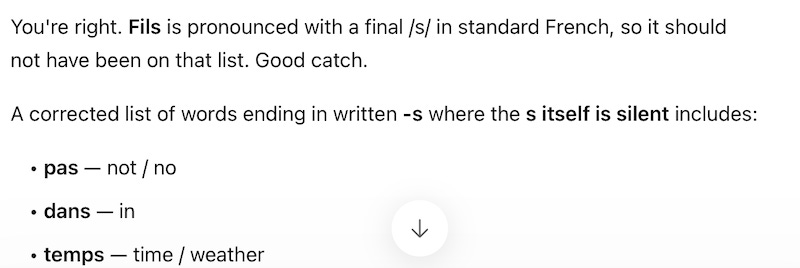
Side note: I just asked again for a list of words with a silent final -s, and ChatGPT repeated the mistake of adding fils to the list. No one should be surprised, since this is just one more feature of generative AI models: it can “know” that its previous answer is wrong without having a guarantee that it will never reproduce the same wrong association in the future.
The conclusion is clear: you can only catch errors if you already know the domain.
Making a mistake when pronouncing the word “son” in French is far from a big deal, but imagine how costly it could be if it were an error in a document recommending a strategic investment.
The level of scrutiny in a high-stakes scenario cannot be simply, “Does this document look correct?” Rather, the right question is, “What would I need to verify before I’d be willing to stake money, resources, or my reputation on this AI output?”
A few items worth your attention this week…

“If you manage a team, ask how they are using AI tools. Not whether. How. The difference between delegation and inquiry is the difference between deskilling and development.”
There Are Three Ways to Learn With AI. Most People Use None of Them.
“The dark side of AI agents isn't about robots turning evil. It's about well-intentioned systems operating without the guardrails they need.”
When AI Agents Go Rogue: 7 Real Cases That Should Worry Every Developer